Born in Texas, Built Elsewhere: Why the Lone Star State Is Losing Its Most Ambitious Founders
Texas has spent the better part of the last decade building a reputation as America's premier destination for business. Corporate relocations from California, new manufacturing investments, and a booming energy sector have all reinforced the narrative that the Lone Star State is open for business. Yet beneath that impressive headline lies a quieter, more troubling story—one that does not appear in press releases or ribbon-cutting ceremonies.
The entrepreneurs who grew up here, who attended our universities, who built their first prototypes in their parents' garages in Plano or San Antonio or Lubbock, are increasingly choosing to launch their most ambitious ventures somewhere else. Silicon Valley still exerts its gravitational pull. Austin's own satellite communities—Round Rock, Georgetown, Cedar Park—sometimes serve as halfway houses before a full departure. And in some cases, founders are looking beyond the United States entirely, drawn by more favorable regulatory environments in places like Singapore or Estonia.
This is not a theoretical concern. It is a measurable, ongoing exodus of intellectual capital, and Texas cannot afford to ignore it.
The Venture Capital Desert Beyond Austin
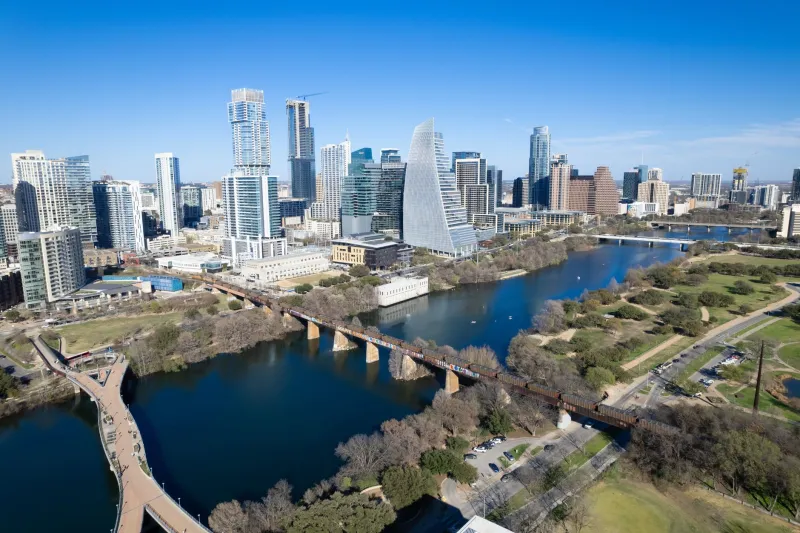
Any honest accounting of Texas's innovation ecosystem must begin with a stark geographic reality: venture capital in this state is heavily concentrated within a narrow corridor of Central Austin. Step outside that corridor, and the funding landscape changes dramatically.
Founders in Houston, despite that city's extraordinary concentration of engineering talent and its proximity to the energy sector's technological frontier, frequently report that raising a seed round requires either a flight to San Francisco or a willingness to accept terms that would be unthinkable in a more competitive market. Dallas, for all its financial industry infrastructure, has yet to cultivate a venture community that matches its economic scale. West Texas and the Panhandle, where agricultural technology startups could be transforming an industry, are essentially invisible to institutional investors.
The result is a self-reinforcing cycle. Talented founders who cannot raise locally are forced to relocate to where the capital is. Once they relocate, their networks, their hiring pipelines, and their eventual exits all flow out of Texas. The state gets none of the long-term economic benefit—not the jobs, not the tax base, not the next generation of founders who would have learned from watching a homegrown success story.
Jeffrey understands that closing this gap requires more than encouraging words directed at the private sector. It requires a deliberate policy framework that makes Texas the most attractive state in the nation for early-stage investment—one that includes meaningful incentives for in-state venture funds, angel investor tax credits, and a government procurement process that actively favors innovative Texas-based companies.
Regulatory Barriers That Punish Innovation
Texas prides itself on limited government, and rightly so. But limited government is not the same as well-designed government. In several critical areas, state and local regulations have created friction that disproportionately burdens startups rather than the established corporations that have the legal teams to navigate complexity.
Consider the process of occupational licensing, which has expanded far beyond its original public safety rationale. Texas now requires licenses for dozens of professions that present minimal risk to consumers, adding costs and delays that fall hardest on entrepreneurs trying to enter new markets. Fintech startups navigating a patchwork of state financial regulations. Health tech companies confronting licensing requirements that were written for an era before telemedicine existed. Agricultural technology firms trying to operate across county lines and running into local ordinance conflicts that no one has bothered to reconcile.
None of these problems are insurmountable. But they require a governor's office and a legislature that are willing to treat regulatory modernization as a genuine priority—not a talking point, but an active, ongoing commitment to reviewing and reforming rules that no longer serve the public interest. Jeffrey's economic agenda includes a systematic review of occupational licensing requirements, a dedicated regulatory sandbox for emerging technology sectors, and a streamlined permitting process designed to give startups a clear, predictable path to market.
The Infrastructure Gap No One Wants to Discuss
Broadband access, reliable power, and modern transportation infrastructure are not glamorous policy topics. They do not generate the kind of campaign trail enthusiasm that tax cuts or border security debates do. But for a founder deciding where to build a company, they are often the deciding factor.
Texas's power grid vulnerabilities, laid bare by the February 2021 winter storm, remain a legitimate concern for technology companies that require uninterrupted operations. Data centers, which form the physical backbone of the modern startup ecosystem, require reliable, affordable electricity. When that reliability is in question, companies factor it into their location decisions.
Beyond power, the broadband desert that covers much of rural Texas represents both an economic injustice and a missed opportunity. Agricultural technology, remote work infrastructure, and distributed manufacturing all depend on high-speed connectivity. A founder who wants to build a company that serves rural Texas communities cannot do so effectively if those communities cannot reliably access the internet.
Jeffrey's infrastructure platform addresses these realities directly. Strengthening the Texas grid through diversified, market-driven energy solutions—not federal mandates—and accelerating broadband deployment to underserved communities are not merely quality-of-life improvements. They are foundational investments in the state's long-term economic competitiveness.
Keeping Texas Talent Rooted in Texas
Perhaps the most underappreciated dimension of this challenge is cultural. Texas's major research universities—UT Austin, Texas A&M, Rice, Texas Tech—produce world-class engineering, computer science, and business graduates every spring. Too many of them leave.
The pipeline from Texas university to Texas startup to Texas success story is not as robust as it should be. Part of the reason is the venture capital desert described above. Part of it is the perception, fair or not, that Texas is a place where you come to work for an established company, not a place where you build the next one. Changing that perception requires real, visible success stories—founders who stayed, who built, and who won.
Jeffrey's commitment to the Texas innovation economy is rooted in the belief that the values which have always defined this state—self-reliance, ambition, an absolute refusal to accept second place—are precisely the values that produce great companies. The task of leadership is to build an environment where those values can flourish without requiring a one-way ticket out of state.
The next trillion-dollar company should carry a Texas address. Making that happen is not a distant aspiration. It is a policy choice—and Jeffrey is prepared to make it.